

Imagine this: You're parked in your campervan by an idyllic lake shore, your coffee is steaming in your cup, your smartphone is charging, and your refrigerator is keeping your supplies fresh. All this is possible thanks to a power station that provides you with 230 volts – completely without a mains power connection. And that's precisely what modern, energy-independent travel offers: You're self-sufficient, flexible, and can live comfortably even away from campsites.
But how do you get electricity safely into your motorhome? As soon as you want to feed the power into the motorhome via the CEE inlet, rather than just using it for individual appliances, things become more technically demanding. Caution is advised here: not every cable that seems suitable at first glance is actually appropriate for this purpose. Incorrect connections can lead to power outages or even dangerous situations.
This article explains which CEE power cable is compatible with your power station and what you should absolutely consider when setting up a power supply in your motorhome. Ideal for anyone who values safety and comfort while camping.
Power station in the motorhome: Power supply while camping without mains power
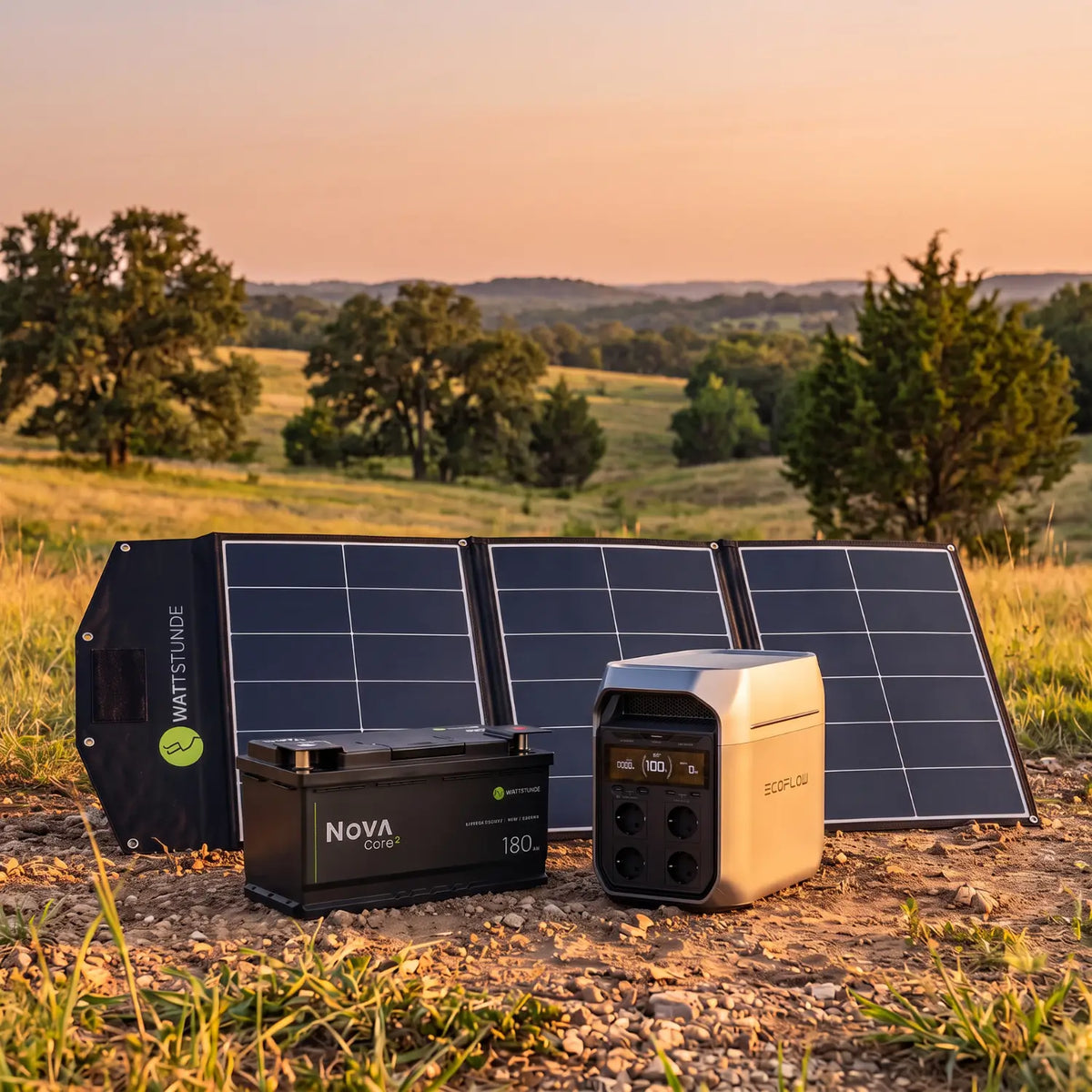
Power stations are portable energy storage devices with an integrated inverter. They convert the stored direct current into 230-volt alternating current, the same voltage you get from a wall socket. The power is then supplied via a standard wall socket. This is perfectly adequate for many applications.
However, the internal workings of a power station differ fundamentally from the electrical system in a house: While a house has a continuous protective system with grounding (PE conductor), many power stations operate with a so-called "floating output." This means there is no fixed grounding point. This can become problematic if you want to feed power into your motorhome's electrical system via the CEE connector. Without adequate protection, a dangerous voltage can build up on the vehicle's chassis. Therefore, the correct power supply cable is crucial.
Comparison: Adapter cables from other manufacturers vs. WATTSTUNDE CEE power supply cable with residual current circuit breaker
Many campers wonder: What are the differences between the various CEE cables for supplying electricity to a motorhome?
The difference between general adapter solutions and a CEE power supply cable specifically designed for power stations with an RCD (residual current device), as offered by WATTSTUNDE, becomes clear.
Technical comparison:
| feature | Cables from other manufacturers | WATTSTUNDE CEE feed-in cable with residual current circuit breaker |
| Plug type | Schuko → CEE | Schuko → CEE |
| Cable length | approx. 1.5 m | 1.67 m |
| RCD protection | Yes, for household networks | Yes, for power stations with floating output |
| Grounding | Mostly not adapted | Specifically designed for power stations |
| Use on the household network | Yes | No |
| Use with power stations | Only conditionally safe | Yes, explicitly recommended |
| Price (approx.) | from €30–40 | approx. €109 |
Why is the correct CEE cable so important for power stations?
Although both cable types look similar, the differences lie in the details. Power stations from brands like EcoFlow or Bluetti operate with "floating outputs," meaning without a fixed grounding point. A simple residual current device (RCD), like those built into standard cables from other manufacturers, often doesn't function reliably in these cases.
When connecting to your motorhome's power supply, there is a risk of a dangerous voltage building up inside the vehicle. Therefore, a specially designed CEE cable, compatible with power stations, is necessary.
A suitable cable should meet the following criteria:
- Residual current circuit breaker for floating outputs
- Robust, splash-proof connectors
- Separation of protective conductor and neutral conductor
- Mechanically robust for outdoor use
The WATTSTUNDE CEE power supply cable with RCD was designed precisely for this purpose and offers maximum safety when camping with a power station.
Which cable is suitable for which purpose?
| Application | Adapter cables from other manufacturers | WATTHOUR CEE power supply cable |
| Operate household appliances on a power station | ✅ | ✅ |
| Power station → Motorhome (CEE power supply) | ❌ (not recommended) | ✅ (safe!) |
| Mains power → Motorhome (CEE inlet) | ✅ | ❌ (not permitted) |
Checklist: How to check if your power supply is safe
Before you feed electricity into your motorhome via your power station, you should check the following points:
- Does the cable used have a residual current device (RCD) specifically designed for power stations with floating output?
- Are the connectors splash-proof (at least IP44)?
- Is the separation between the protective earth (PE) and neutral conductor (N) correctly implemented?
- Is the cable mechanically stable and designed for outdoor use?
- Has the power supply already been tested in practice – e.g. with a simple consumer such as a lamp?
If you can answer all questions with "yes", your configuration is basically safe – ideal for carefree camping with power supply via the power station.
Practical example: This is what a safe power supply with a power station looks like.
Let's assume you're using a modern power station like the EcoFlow DELTA 3. You connect the WATTSTUNDE CEE power supply cable with residual current circuit breaker (RCCB) to the integrated Schuko socket. This safely delivers the generated power to the CEE input of your motorhome.
The integrated residual current device (RCD) in the cable is specifically designed for the power station's "floating output" technology and reliably detects fault currents – even without a conventional grounding point. The robust, splash-proof connections ensure safe operation even in damp weather.
The onboard electrical system powers the refrigerator, lights, chargers, and water pump just like any other device – as if you were connected to a campsite's electrical hookup. This turns your power station into a mobile energy hub for off-grid travel.
Conclusion: The right CEE cable for your power station when camping
If you only use your power station for household appliances such as kettles, laptops or lights, direct use of the Schuko socket is sufficient.
However, if you want to feed power into your motorhome's electrical system via the CEE connection, things become more technically complex. The WATTSTUNDE CEE power supply cable with integrated residual current circuit breaker (RCCB) is the safe solution here. Designed for power stations with floating output, it offers the appropriate protection and robust technology for everyday camping use.
Invest in the right power supply – for greater safety, comfort, and independence while camping. With the right CEE cable, you'll be perfectly equipped for any outdoor situation.
If you would like to know more about the CEE power supply cable, please check out our guide !